

Blogs
Braces or Clear Aligners? Choosing the Right Treatment for Your Child
Crooked, crowded, or misaligned teeth can affect your child's oral health, bite, speech, and confidence. Fortunately, modern orthodontic treatments offer effective solutions to correct these issues and create a healthy, well-aligned smile. The two most common treatment options are traditional braces and clear aligners.
Every child is unique, and the best orthodontic treatment depends on their age, dental development, and the complexity of the alignment problem. Understanding the differences between braces and clear aligners can help parents make an informed decision.
When Does a Child Need Orthodontic Treatment?
An orthodontic evaluation helps identify problems with the growth of the jaws and the alignment of teeth. Early assessment allows the pediatric dentist or orthodontist to recommend the right treatment at the most appropriate time.
- Crooked or crowded teeth.
- Gaps between teeth.
- Overbite or underbite.
- Crossbite or open bite.
- Difficulty chewing or biting.
- Improper jaw growth or tooth positioning.
What Are Traditional Braces?
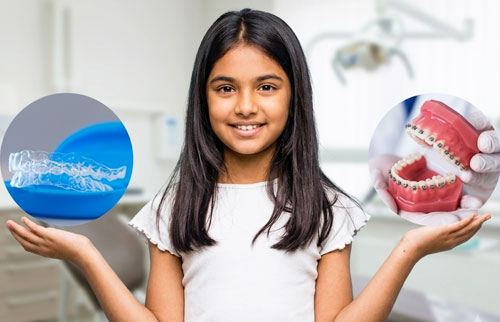
Traditional braces use metal or tooth-colored brackets connected by wires to gradually move teeth into their correct position. They are highly effective for treating both simple and complex orthodontic problems and remain one of the most reliable treatment options for children.
Benefits of Braces:- Suitable for mild to complex alignment problems.
- Fixed to the teeth, so treatment does not depend on patient compliance.
- Provides predictable and effective results.
- Available in metal and tooth-colored options.
What Are Clear Aligners?
Clear aligners are transparent, removable trays that gradually move teeth into proper alignment. They are custom-made for each child and are nearly invisible when worn, making them a popular choice for older children and teenagers with mild to moderate orthodontic concerns.
Benefits of Clear Aligners:- Virtually invisible appearance.
- Comfortable with no metal brackets or wires.
- Removable while eating and brushing.
- Makes maintaining oral hygiene easier.
Braces vs. Clear Aligners
- Appearance: Braces are visible, while clear aligners are nearly invisible.
- Comfort: Clear aligners generally cause less irritation to the cheeks and lips.
- Oral Hygiene: Aligners can be removed for brushing and flossing.
- Treatment Complexity: Braces are ideal for both simple and complex orthodontic cases.
- Discipline Required: Aligners must be worn as instructed to achieve the desired results.
- Results: Both treatments are highly effective when selected appropriately.
How Is the Right Treatment Selected?
The choice between braces and clear aligners depends on several factors, including your child's age, jaw growth, bite, tooth alignment, oral hygiene habits, and the complexity of the orthodontic problem. After a detailed clinical examination and digital evaluation, the dentist recommends the most suitable treatment plan for your child.
Tips for Parents During Orthodontic Treatment
- Encourage your child to maintain excellent oral hygiene.
- Attend all scheduled orthodontic appointments.
- Follow dietary recommendations provided by the dentist.
- Ensure aligners are worn for the recommended number of hours each day.
- Report any discomfort or appliance damage promptly.
- Support and motivate your child throughout the treatment journey.
Expert Orthodontic Care at Everyouth Dental Clinic
At Everyouth Dental Clinic, we provide comprehensive orthodontic care for children using modern braces and clear aligner systems. Our experienced team carefully evaluates your child's dental development and creates a personalized treatment plan designed to achieve healthy alignment, proper bite function, and a confident smile.
Book an orthodontic consultation today and find the most suitable treatment option to give your child a healthy, beautiful smile for life.